Connecting the Dots: NextGen Policy’s Tiffany Germain on Building Stronger Food Systems
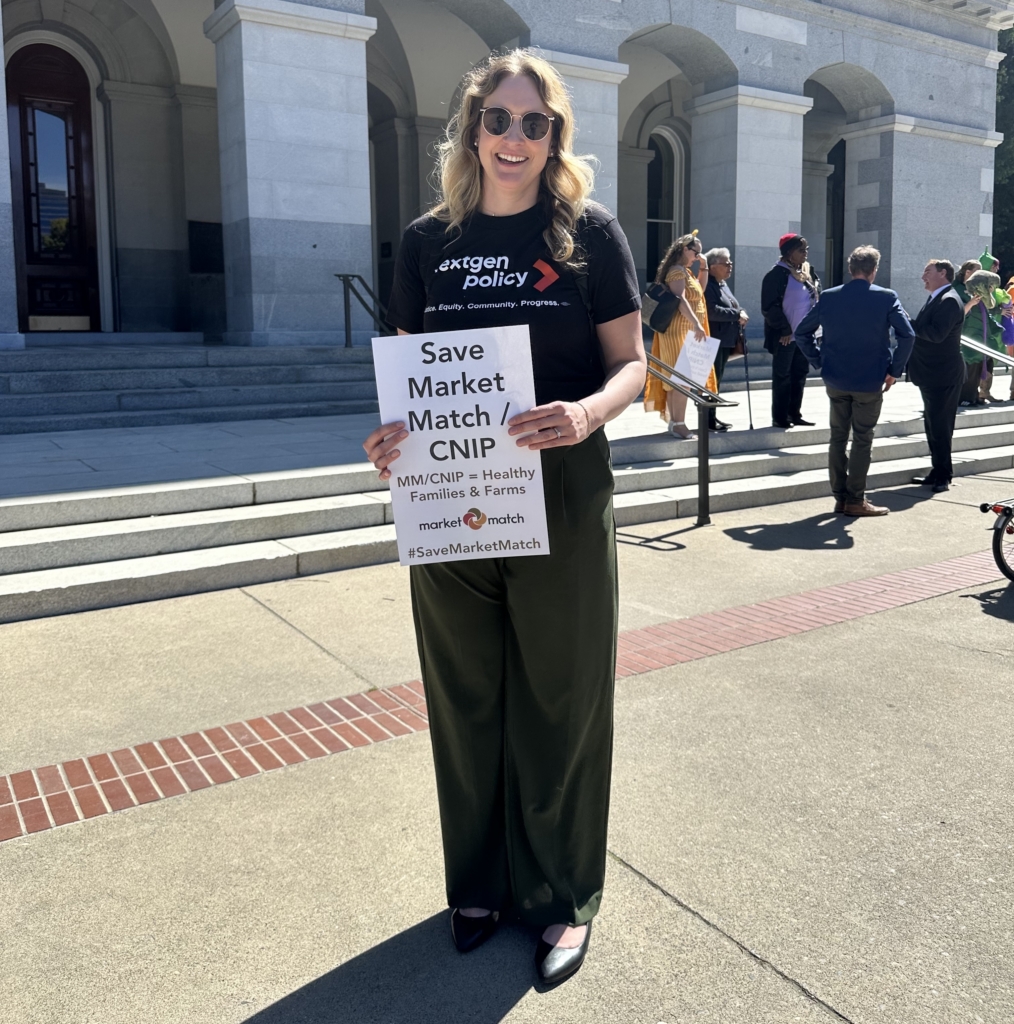
There are people who grow our food, people who prepare it, people who serve it, and people who help shape the systems that make it all possible. Tiffany Germain has spent her career making sure those worlds stay connected.
As Research & Policy Advisor for NextGen Policy, Tiffany helps advance some of California’s most powerful food initiatives. Her work has been instrumental in establishing the nation’s first School Meals for All program, expanding Farm to School partnerships, increasing access to farmers’ markets, and broadening healthy food access statewide. Together, these efforts reflect a vision to transform California’s food system by strengthening every link in the chain, from farms and schools to families and communities.
Yet when asked why she does this work, Tiffany doesn’t start with policy–she starts with people.
“I realized that food is the thing that connects so many of the issues I care about,” she said. “Climate change, health, education, families. It’s not just what we eat. It’s how it connects us.”
That belief has shaped Tiffany’s journey from her childhood in North Carolina, where agriculture was part of daily life, to representing her home state on Capitol Hill, and now to California and her work at NextGen Policy, where she helps build stronger, more equitable food systems.
Rooted in Connection: Policy Built on Listening
Growing up, food wasn’t simply something her family shared; it was how they showed love.
“My dad is the chef of our family,” she shared. “Every time I go home, I want him to cook my comfort food.”
When asked to finish the sentence “Food is…” Tiffany didn’t hesitate: “Connection. It’s how we care for one another. Someone has a baby, someone is sick, someone is celebrating, you show up with food.”
That same philosophy shapes her approach to policy. While much of her work happens behind the scenes, Tiffany sees policy as an exercise in active listening and intentionally engaging farmers, school nutrition professionals, educators, families, and community leaders to translate lived experiences into lasting change.
“It’s easy to assume we understand what people need,” she reflected. “But trust starts with listening.”
For Tiffany, effective food systems aren’t built by solving isolated issues, but by recognizing how deeply every element relies on the others. Agriculture, food access, infrastructure, and workforce development are not separate challenges, but interdependent pieces of a system centered on human connection.
“The farmer is growing the food for a school meal program. The cafeteria worker is preparing the food for the kids. The policymaker is creating the conditions for those programs to succeed,” she explained. “It’s all the same story.”
Honoring the Resilience of Women Farmers
That perspective feels especially fitting during the International Year of the Woman Farmer.
While Tiffany isn’t a farmer herself, years of collaborating with women farmers across California have deeply shaped her outlook. Supporting women in agriculture, she notes, goes beyond celebrating contributions; it also means building systems that enable them to thrive.
“I think about the resilience of having to navigate so many barriers while building successful operations in a male-dominated field,” she said. “But what has really struck me is how collaborative they are. They’re constantly bringing people in, sharing what they know, and building community.”
She sees those same qualities reflected across women throughout California’s food system.
“I think women understand that lasting change isn’t going to happen unless we’re working together,” she said. “They’re good at listening to different experiences and collaborating to build solutions that actually work.”
Embracing Empathy & Human-Centered Leadership
Earlier in her career, Tiffany felt she needed to hide parts of herself to be taken seriously.
“I thought I had to separate my more sensitive side from my work,” she admitted. “I thought vulnerability was something I needed to hide.”
That changed after joining NextGen Policy, where she found mentorship through Adriana Sanchez-Ochoa, the organization’s Chief Deputy Director.
“She showed me that vulnerability and empathy aren’t weaknesses—they’re strengths,” Tiffany said. “Working here changed my life because I realized I could be who I am and still do this work well.”
Those lessons continue to shape her approach to leadership today.
“The thing that motivates me is the people,” she said, recalling a legislative briefing where a high school student described transitioning from receiving free and reduced-price meals to participating in California’s universal school meals program. Instead of focusing on the food, the student talked about belonging.
“He spoke about feeling embarrassed before, and then feeling included,” Tiffany remembered. “It was one of the most moving moments of my career.”
Moments like that keep her grounded in the mission: “Sometimes you spend your days behind a desk or in Zoom meetings. But when you actually meet the people whose lives are being impacted, that’s when it becomes personal.”
Reflections for the Next Generation
Looking ahead, Tiffany hopes California continues to lead the nation by expanding healthy food access and investing in the systems behind it. She sees vital opportunities to eliminate food deserts, strengthen local food economies, and help consumers better connect with the origins of their food.
“I wish more people understood where their food comes from,” she said. “So often we go to the grocery store and never think about it again. But meeting the people who grow our food changes the way you see the entire system.”
Asked what advice she would offer young women hoping to make a difference in this space, her answer echoed the values that have guided her own journey.
“Focus on your strengths,” she said. “There’s a tendency to think making an impact means being the loudest voice in the room or having all the answers.” Tiffany proves that true leaders lead by elevating others. By ensuring every voice across the system is heard, she drives home a core belief: lasting change doesn’t start with legislation, but with listening.